

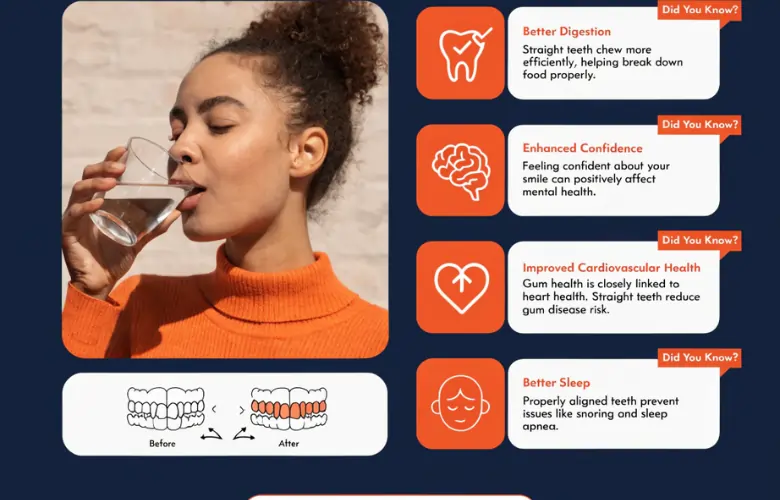
Many individuals believe that orthodontics is primarily about aesthetics and confidence. While this is a significant aspect, it is not the only benefit. The arrangement of your teeth directly impacts the health of your gums, your digestion, your jaw, and can even affect conditions throughout your body that don’t seem related to your mouth.
Crooked teeth create a cleaning problem you can’t brush away
When teeth are not properly aligned, it’s not just a cosmetic issue – it can have a real impact on oral hygiene and overall health. Overlapping and crowded teeth provide hiding spots for bacteria that lead to plaque build-up, cavities, and gum disease. Crooked teeth can also cause uneven wear on the teeth, as they do not come together evenly when you bite down. This can lead to issues with your jaw over time.
Modern solutions make it easier to address
For decades, getting your teeth straight involved a year or longer with fixed metal hardware in your mouth. As a result, many adults chose to do nothing about the problems they’d lived with since their teenage years.
That all changed when clear aligner therapy came along. Removable straightening teeth aligners also meant you could take your appliance out to eat and clean your teeth normally – with no brackets to trap food and no wires to make flossing a laborious task. For people who struggled with their dental hygiene because of crowding, the fact they are removable makes them a clinical advantage of the treatment, not just a convenience.
Your teeth move slowly through a series of custom-made aligners, and the treatment time for mild to moderate cases is often shorter than with traditional orthodontics.
What misalignment does to your jaw
Bite issues are not limited to affecting your teeth only. When upper and lower teeth do not perfectly align, your jaw compensates for this every time you chew or clench your teeth. This compensation causes uneven pressure on the temporomandibular joint, which is the hinge that connects your jaw to your skull.
Issues with your TMJ can cause chronic headaches, ear pain, and jaw stiffness, which appear to have no relation to dental health. Many people suffer from these symptoms for years without being able to identify the cause. Bruxism, which is the medical term for involuntary grinding of the teeth, often arises when the jaw attempts to find a more comfortable resting position due to the inability of a misaligned bite to allow for it. Your teeth then grind against each other, causing tooth erosion.
By fixing the alignment of your teeth, bite force is distributed evenly across all teeth. This one simple change eliminates the stress concentration, which is the root cause of the degeneration of your joints and the grinding cycle.
The digestion connection most people overlook
It all begins in the oral cavity. Many people are surprised to learn that digestion starts in the mouth, not the stomach. And that your teeth and jaws are not just there to process nutrients. They’re also part of a carefully evolved system where each link in the digestive chain depends on the one before it.
The jaws, teeth, and muscles will evolve to chew what they’re fed. When malocclusion leads to insufficient chewing, larger, less thoroughly processed food particles make their way to the digestive system. This may cause the stomach and intestines to work harder to break down and digest food, making it difficult for the body to access essential nutrients and macronutrients.
The connection between oral health and the rest of your body
More and more research has shown that prolonged oral infection and inflammation also mess with the endothelial cells that line the blood vessels. Those cells help regulate the permeability and clotting tendencies of the blood, among other things. That’s a major reason for why gum disease is such a consistent predictor of forms of cardiovascular dysfunction like stroke and atrial fibrillation.
Confidence is still part of the picture
It’s important to recognize that there’s an emotional component as well. Individuals who feel self-conscious about their teeth smile less, avoid social interactions, and sometimes even harbor that stress as long-term chronic anxiety. Heightened cortisol levels due to constant social stress can have serious physical effects.
If we present orthodontic care as a matter of appearance only, we are undermining the impact it can have on a person’s quality of life. The functional and emotional advantages are not mutually exclusive – they build on each other.
Straight teeth are not simply nicer to look at. They are also easier to maintain, better for your digestive system, and less likely to result in chronic inflammation that compromises your well-being. The beautiful appearance is an additional benefit of something that is beneficial to your overall health.
