

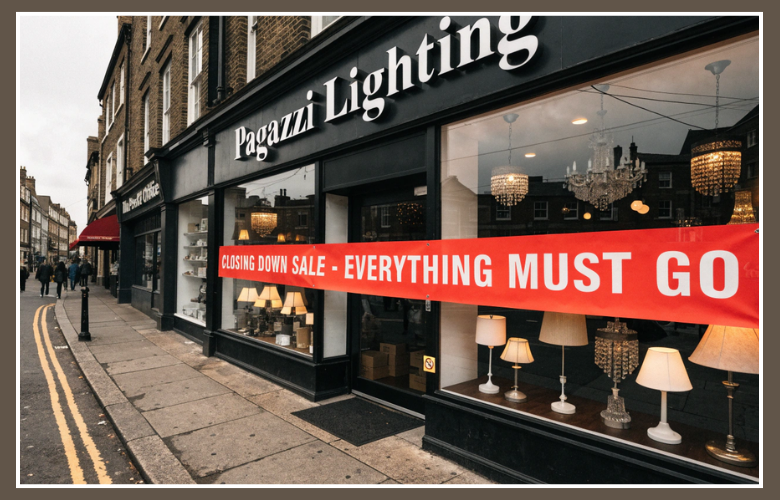
The Pagazzi Lighting administration has become an important UK retail story after the specialist lighting and home interiors business underwent another major period of financial difficulty in 2026. Pagazzi was known for its lighting, furniture and home décor ranges and built a sizeable physical retail presence, particularly across Scotland and northern England.
The latest developments have created understandable confusion because several companies connected with the Pagazzi name have different legal statuses. Pagazzi Lighting (Concessions) Limited entered administration on 26 February 2026, while Pagazzi Lighting (Services) Limited also entered administration. At the same time, Pagazzi Lighting (Web) Limited remains an active company with internet and mail-order retail listed as its business activity.
For customers, employees and people following UK retail closures, this distinction matters. The physical store network has been dramatically affected, but the Pagazzi brand has not simply vanished. Understanding what happened, why the business faced pressure and which part of the company continues is essential to understanding the retailer’s current position.
What Happened to Pagazzi Lighting UK?
Pagazzi Lighting developed its reputation as a specialist retailer selling lighting and wider home interior products. Its stores provided customers with an opportunity to see products in person, compare different designs and get a better idea of how furniture and lighting would look in a real room.
The business later faced financial difficulties that affected its traditional store-based operation. Companies House records show that Pagazzi Lighting (Concessions) Limited entered administration on 26 February 2026.
Pagazzi Lighting (Services) Limited also entered administration, with Companies House records showing an administrator was appointed in March 2026 and that the administrator’s proposals were subsequently approved.
The situation is more complicated than simply saying that the whole Pagazzi brand has disappeared.
Pagazzi Lighting (Web) Limited is separately registered and remains an active company. Its stated business activity is retail sale through mail-order houses or via the internet.
That means the physical retail business and the continuing online operation need to be considered separately.
Why Did Pagazzi Lighting Go Into Administration?
There is no single factor that explains why a specialist retailer experiences financial distress. Businesses operating physical stores have to manage a combination of property costs, staffing, energy, stock, logistics and other overheads.
Lighting and furniture retailers can face additional challenges because they often require relatively large showrooms. Customers benefit from being able to see products in person, but the space needed to display large lighting fittings and furniture can be expensive to operate.
Consumer behaviour has also changed significantly.
A customer looking for a pendant light, floor lamp or mirror can now compare hundreds of products online before deciding what to buy. Price comparison, online reviews, delivery options and promotional offers can all influence purchasing decisions.
This creates a difficult environment for a traditional showroom-led retailer.
A physical store may generate valuable customer engagement but still be difficult to operate profitably if sales volumes and margins do not adequately cover its fixed costs.
For Pagazzi, the eventual restructuring shows how difficult that balance can become.
Pagazzi Lighting Administration Closures
The Pagazzi Lighting administration closures represent one of the most significant consequences of the company’s financial problems.
The retailer’s physical store network was substantially reduced during the 2026 restructuring, with 11 stores closing and around 70 jobs affected according to contemporary reporting on the administration.
For customers, the closure of physical stores represents more than the loss of a convenient shopping location.
Lighting is a product category where customers often want to see an item before purchasing. They may want to judge its size, finish, colour, brightness and overall appearance.
Furniture presents the same issue.
A photograph cannot always communicate the true scale of a dining table, sofa, cabinet or mirror.
Pagazzi’s stores therefore offered a showroom experience that online shopping cannot completely reproduce.
However, showrooms also carry significant costs. The closures can therefore be viewed as an attempt to reduce the financial burden associated with the previous physical retail model while allowing the brand’s online presence to continue.
How Many Pagazzi Stores Closed?
Eleven physical Pagazzi stores closed during the latest restructuring.
The closures represented a substantial reduction in the retailer’s physical footprint and marked a major change from the store-based model for which Pagazzi had become known.
A large network of stores can be useful for brand visibility and customer experience, but it also creates a considerable cost base.
Every location requires premises, employees, utilities, insurance, stock management and ongoing maintenance.
When customer behaviour changes, individual stores can become difficult to justify financially.
The Pagazzi closures therefore demonstrate an important issue facing modern UK retailers: a shop can remain popular with some customers while still being commercially difficult to maintain.
For former Pagazzi shoppers, the most obvious consequence is that a local showroom may no longer exist.
For the company, however, closing stores can reduce fixed expenditure and allow more attention to be directed towards online retail.
What Happened to Pagazzi Employees?
Around 70 employees were affected by redundancies connected with the store closures.
For those workers, the administration was much more than a change in corporate structure. It meant uncertainty about employment, income and future work.
Retail administrations can have a particularly strong local impact because stores often employ people from nearby communities.
When a specialist retailer closes several locations, the consequences can extend beyond the company itself. Employees lose jobs, local shopping areas lose established businesses and surrounding retailers may experience changes in customer traffic.
Employees affected by an administration should rely on official insolvency and employment information relating to their particular employer.
This is important in the Pagazzi case because several companies have operated under similar names.
The legal entity employing an individual can affect how their employment situation is handled.
That corporate distinction is therefore relevant not only to investors and creditors but also to former employees.
Why Did Pagazzi Close Its Physical Stores?
The store closures can be understood within the wider transformation of UK retail.
Traditional retailers face competition from businesses that can sell nationally through websites without maintaining an extensive network of large premises.
This does not mean physical retail has become unnecessary.
For lighting and interiors, physical stores can still offer a valuable advantage. Customers can examine materials, compare colours and understand the scale of products before buying.
The problem is the cost of providing that experience.
A showroom needs sufficient floor space to create an attractive display. It also needs staff who can assist customers and stock that can be transported and managed efficiently.
When margins become tighter, those expenses can become difficult to support.
Pagazzi’s restructuring illustrates the challenge of finding the right balance between physical retail and e-commerce.
The company now has considerably less exposure to the costs associated with a large store estate, but it must compete much more directly in the crowded online market.
What Products Did Pagazzi Lighting Sell?
Pagazzi became particularly associated with lighting but expanded its offering into broader home interiors.
Its product categories included a variety of decorative and practical items designed for different areas of the home.
Common categories associated with the retailer included:
- Ceiling lights
- Pendant lights
- Chandeliers
- Wall lights
- Table lamps
- Floor lamps
- Outdoor lighting
- Mirrors
- Furniture
- Rugs
- Wall décor
- Dining products
- Decorative accessories
This wider range allowed Pagazzi to appeal to customers working on complete room makeovers rather than individual lighting purchases.
Someone redesigning a dining room, for example, might need a pendant light as well as furniture, a mirror and decorative accessories.
The strategy also encouraged customers to view Pagazzi as a home interiors destination.
However, the broader range required substantial showroom space, which increased the importance of physical retail economics.
That makes the store closures particularly significant for understanding the company’s strategic change.
Why Did People Choose Pagazzi?
One of Pagazzi’s strongest advantages was its specialist focus.
Customers searching for lighting could browse a wide range of designs in one place rather than visiting several general homeware retailers.
The physical showroom also provided inspiration.
Lighting is not simply a functional purchase. A fitting can influence the atmosphere, proportions and visual character of a room.
Being able to see several products displayed together helped customers make decisions that can be difficult to make from a small product image.
Staff knowledge could also be valuable.
Customers may need advice about dimensions, installation, bulb compatibility, room suitability or the relationship between a fitting and existing furniture.
The move towards online retail removes some of these advantages.
For Pagazzi’s continuing business, one of the biggest challenges will therefore be translating its specialist retail knowledge into a strong digital customer experience.
Detailed descriptions, accurate measurements, useful imagery and responsive support become much more important when customers cannot visit a showroom.
What Are the Benefits of the Restructuring?
Administration is usually associated with financial distress, but restructuring can also create an opportunity to reduce an unsustainable cost base.
For Pagazzi, the continuing online operation means the brand can potentially serve customers without maintaining the same number of expensive physical locations.
Possible advantages include:
- Lower property-related costs
- Reduced store overheads
- Nationwide online reach
- Greater focus on e-commerce
- More flexibility in product presentation
- Potentially simpler operations
- Ability to concentrate resources on profitable areas
An online model also makes it easier to reach customers outside the areas where Pagazzi historically operated stores.
Someone in a part of the UK without a nearby showroom can potentially access the brand digitally.
However, these benefits do not guarantee a successful recovery.
Online retail is highly competitive and customers can switch between retailers quickly.
The continuing business must therefore use its specialist reputation and product knowledge to create a compelling reason for customers to buy from Pagazzi rather than another online retailer.
What Are the Pros and Cons?
The restructuring has both clear advantages and serious disadvantages.
Potential advantages include:
- The Pagazzi brand continues to have an online presence.
- The active web company can serve customers beyond former store locations.
- A smaller physical operation can reduce fixed costs.
- Resources can be redirected towards e-commerce.
- The business can potentially operate with greater flexibility.
The disadvantages include:
- Eleven physical stores closed.
- Around 70 jobs were affected.
- Customers lost local showrooms.
- Product demonstrations became less accessible.
- The brand has a smaller physical presence.
- Online competition is extremely intense.
The biggest question is whether the savings created by the reduction in physical retail can outweigh the revenue and customer experience previously generated by stores.
That will depend on the performance of the remaining online operation.
The restructuring should therefore be viewed as a major change in business model rather than proof that the company has fully recovered.
Pagazzi Lighting and the Wider UK Retail Market
The Pagazzi situation reflects a much broader trend across British retail.
Many established retailers are reconsidering the role of physical stores as consumers increasingly research and purchase products online.
The pressure is particularly strong for businesses with large premises and significant fixed costs.
A store has to provide more than a place to complete a transaction.
It needs to offer convenience, expertise, inspiration or an experience that customers cannot easily replicate online.
This is especially relevant to home interiors.
A customer may still want to see a lamp, sofa or dining table in person, but they may use the internet to compare prices and read reviews before making the final decision.
Retailers therefore need to understand how customers move between physical and digital channels.
Pagazzi’s experience illustrates what can happen when the economics of a large showroom network become increasingly difficult to sustain.
The future of UK retail is unlikely to be entirely online or entirely physical. A combination of digital convenience and carefully selected physical experiences may prove more sustainable.
What Happened to the Original Pagazzi Lighting Company?
Another reason the administration story can be confusing is Pagazzi’s corporate history.
Pagazzi Lighting Limited, company number SC232732, entered administration on 29 September 2023. Companies House records show that its administration ended on 27 March 2026 and that the company was dissolved on 27 June 2026.
That company should not automatically be treated as identical to every other business carrying the Pagazzi name.
Pagazzi Lighting (Concessions) Limited is a separate company and entered administration on 26 February 2026.
Pagazzi Lighting (Services) Limited is also a separate company and is recorded as being in administration.
Meanwhile, Pagazzi Lighting (Web) Limited remains active.
This explains why searches about Pagazzi can produce apparently conflicting results.
One company may be dissolved while another is in administration and another remains active.
Is Pagazzi Lighting Still Trading?
Yes, the current Companies House record shows that Pagazzi Lighting (Web) Limited remains active.
The company is registered under the Pagazzi name and has a business classification covering retail through mail order or the internet.
This is an important distinction when discussing the future of the brand.
The closure of the physical stores does not mean that every Pagazzi-related business has ceased trading.
Instead, the retailer’s structure has changed significantly.
Customers may therefore still encounter Pagazzi online even though they can no longer visit many of the physical stores that previously operated under the brand.
The online model also gives Pagazzi an opportunity to reach customers across the UK without recreating the previous store network.
However, continued operation is not the same as guaranteed long-term stability.
The business will still need to generate sufficient revenue and maintain healthy margins while competing with numerous online lighting and home interiors retailers.
What Does the Administration Mean for Customers?
Customers who have bought from Pagazzi should keep records of their transactions.
This is particularly important if there is an outstanding delivery, refund, return, warranty issue or other unresolved matter.
Useful records include:
- Receipts
- Order confirmations
- Invoices
- Payment records
- Delivery details
- Warranty documents
- Customer service correspondence
The relevant company matters because different Pagazzi entities have different legal statuses.
A historic transaction involving a company that entered administration should not automatically be treated in the same way as a new purchase from the continuing online company.
Customers should therefore identify the company connected with their transaction and use current information when dealing with any outstanding issue.
For higher-value purchases, consumers should also consider their payment method and any protections that may apply.
The safest approach is to keep detailed documentation rather than relying solely on a brand name.
Is Pagazzi Lighting Still Worth Buying From?
The administration does not automatically mean that every Pagazzi product is poor value or that customers should avoid the brand.
A sensible buying decision should focus on the individual product and the terms of the transaction.
For smaller purchases, customers may mainly want to compare price, design and availability.
For expensive furniture or larger lighting installations, additional checks are worthwhile.
Before purchasing, consider:
- Product dimensions
- Materials and finish
- Stock availability
- Delivery times
- Returns terms
- Warranty arrangements
- Installation requirements
- Payment method
- Customer support
It is also sensible to compare equivalent products from other retailers.
The fact that a company has undergone financial restructuring is relevant, but it is only one part of a purchasing decision.
Customers should look at the current business rather than assuming that its previous store network and present online operation are identical.
What Can Other Retailers Learn From Pagazzi?
The Pagazzi story offers several useful lessons for other UK retailers.
The first is the importance of controlling fixed costs.
A retailer can have a recognised name and loyal customers but still struggle if the cost of maintaining its physical estate is too high relative to its sales and margins.
The second lesson is the importance of adapting to customer behaviour.
Consumers now expect retailers to provide accurate online information, competitive pricing, convenient delivery and straightforward customer service.
The third lesson concerns the role of physical stores.
A shop needs to provide a clear commercial benefit rather than existing simply because it has always been there.
For specialist retailers, this may mean using fewer locations as showrooms while investing more heavily in online services.
Pagazzi demonstrates that successful retail increasingly requires a balance between physical experience and digital convenience.
What Could Happen to Pagazzi Next?
The future of Pagazzi is likely to depend heavily on the performance of its continuing online operation.
The brand has an established history in lighting and home interiors, which gives it recognition that a completely new online retailer would not have.
Its specialist background could also provide an advantage if the company can communicate that expertise effectively online.
However, digital retail is intensely competitive.
Customers can compare products, prices, delivery options and reviews almost instantly.
Pagazzi will therefore need to compete through a combination of product range, pricing, availability, customer service and specialist knowledge.
The reduced physical footprint could potentially make the business more flexible.
Instead of supporting a large network of stores, resources can be directed towards areas such as e-commerce, stock management and digital customer experience.
The administration has therefore ended much of the previous Pagazzi retail model, but it has not necessarily ended the brand.
The next stage will depend on whether the continuing business can establish a sustainable online-focused model.
Frequently Asked Questions
What happened to Pagazzi Lighting?
Pagazzi’s physical retail operation experienced major financial difficulties in 2026, leading to the administration of several related companies and the closure of 11 stores. A separate online company, Pagazzi Lighting (Web) Limited, remains active.
How many Pagazzi stores closed?
Eleven physical stores closed during the 2026 restructuring, significantly reducing the brand’s bricks-and-mortar presence.
Is Pagazzi Lighting still trading?
Pagazzi Lighting (Web) Limited remains an active company. Companies House records its business activity as retail sale via mail order houses or the internet.
When did Pagazzi Lighting enter administration?
Pagazzi Lighting Limited entered administration on 29 September 2023. A separate company, Pagazzi Lighting (Concessions) Limited, entered administration on 26 February 2026.
What happened to Pagazzi employees?
Around 70 employees were affected by redundancies following the closure of the physical stores during the 2026 restructuring.
Why did Pagazzi close its stores?
The closures occurred amid financial difficulties affecting the store-based operation. The wider pressures facing physical retail include high operating costs, changing consumer behaviour and strong online competition.
Conclusion
The Pagazzi Lighting administration is best understood as a major restructuring of a long-established UK lighting and home interiors retailer rather than a simple disappearance of the brand.
The 2026 financial difficulties resulted in the closure of 11 physical stores and affected around 70 employees. Several companies connected with the Pagazzi name have different legal statuses, which explains why information about the retailer can initially appear confusing.
Pagazzi Lighting Limited entered administration in 2023 and was later dissolved, while Pagazzi Lighting (Concessions) Limited and Pagazzi Lighting (Services) Limited are in administration. At the same time, Pagazzi Lighting (Web) Limited remains active as an internet and mail-order retailer.
For customers, the most important point is that the physical store network has changed dramatically, but the Pagazzi name continues online.
For the wider UK retail sector, the case highlights the challenge of balancing expensive physical showrooms with the growing importance of e-commerce.
The future of Pagazzi will ultimately depend on whether its remaining online operation can combine its established specialist reputation with a sustainable, competitive digital retail model.
