

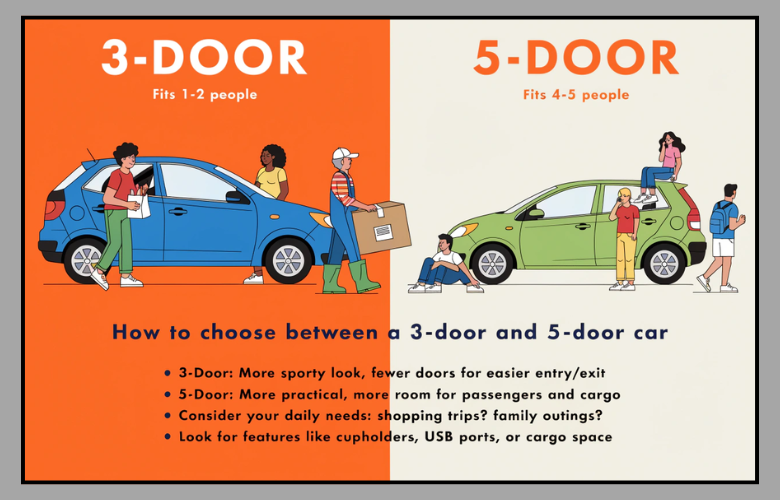
Despite the rise of SUVs, hatchbacks still quietly do a brilliant job. They’re easy to live with, not too big for tight streets, and you can still get them with all sorts of engines and gearboxes depending on what you’re after. Whether you want something economical for commuting or a bit more punch for longer runs, there’s usually a hatchback that fits the bill.
But there’s one choice that often gets brushed over, and it shouldn’t. That’s deciding between a 3-door and a 5-door. It might not sound like much on paper, but it does change how you’ll use the car day to day. Some models only come one way, others give you both options, so it’s worth slowing down and thinking about it properly.
What’s In the Name?
First things first, the naming confuses a lot of people. A 5-door car actually means four side doors plus the boot, which manufacturers also count as a door. A 3-door is just two side doors plus the boot. It’s one of those bits of car jargon that makes sense once someone explains it, but feels a bit odd until then.
If you’re not sure how many doors a vehicle has, you can find out for free with a car check. All you need is the registration number, and the details will appear as part of a free check.
A Matter of Space
Now, in terms of space, you might expect a big difference, but it’s not quite like that. The actual rear seat room is often pretty similar between the two. Where things change is how usable that space feels. In a 3-door, the front doors are usually quite long and the rear access can feel a bit tight. You end up folding seats forward and squeezing in, which is fine occasionally but not ideal if you’ve got people in the back regularly.
A 5-door just makes life easier. You open the rear door and you’re in. Simple as that. If you’ve got kids, or you’re regularly giving lifts to friends, you’ll appreciate it very quickly. No awkward stretching, no climbing in from the front every time someone needs help with a seatbelt.
It also makes loading things much less of a burden. Think about everyday stuff like a child seat, a pushchair, shopping bags, or even something bulky from the garden centre. With rear doors, you’ve got proper access, and folding the seats down is far less of a struggle.
That said, 3-door cars do have one small advantage when it comes to access. The front doors are usually longer, so getting into the front can feel a bit more open when you do use them. It’s not a game changer, but it is there.
Cost It Up
Cost is another factor. A 3-door version is usually a bit cheaper, often by a few hundred pounds. It’s not a massive difference, but if you’re watching your budget or trying to keep monthly payments down, it might sway you. You’re basically paying a bit extra for convenience.
Then there’s the look of the thing, and this is where people often get quite opinionated. A lot of drivers prefer the cleaner, more compact profile of a 3-door. It tends to look a bit sportier, a bit more “tight” in its proportions. Without those rear doors, designers can shape the side profile in a slightly more flowing way, especially around the rear window and roofline.
So it really comes down to how you’ll use the car. If it’s mainly you, maybe one passenger now and again, and you like the idea of a slightly sharper-looking car while saving a bit of money, a 3-door makes sense.
But if you want something that just fits into everyday life without any hassle, especially if you carry passengers or load things regularly, a 5-door is the easier choice. It’s one of those decisions you only really notice once you’ve lived with the car for a while.
