

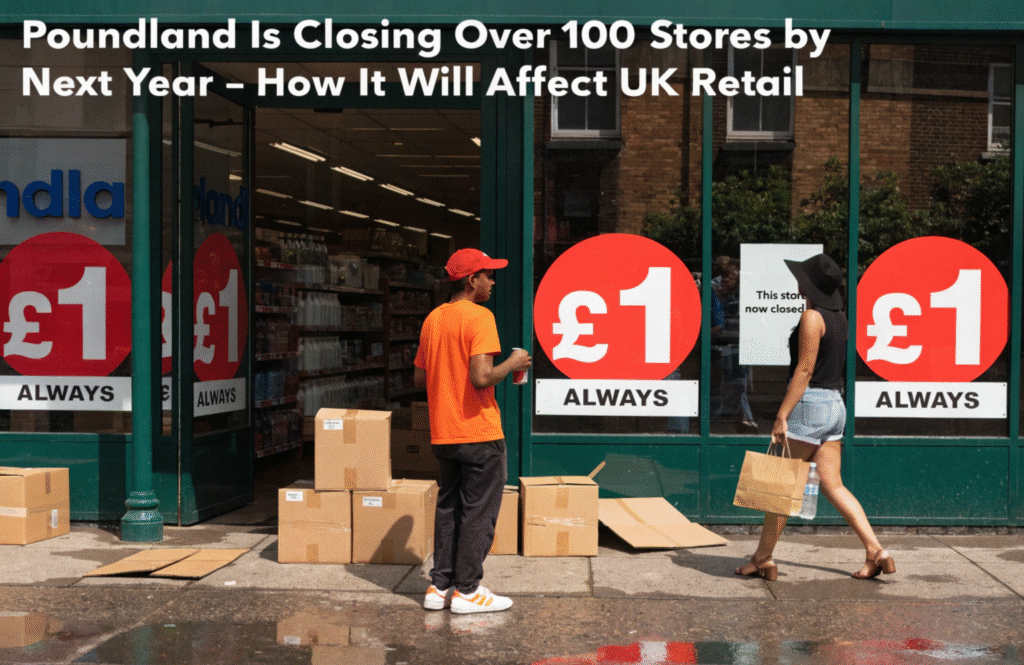
The announcement that Poundland is closing over 100 stores by next year has sent shockwaves through the UK retail sector, affecting communities, employees, and shoppers nationwide. Known for its iconic £1 pricing strategy and high street presence, Poundland has faced rising operational costs, declining sales in certain locations, and increasing competition from online platforms and rival discount chains. Under the ownership of Gordon Brothers, the retailer is undertaking a strategic restructuring to focus on profitable locations while closing underperforming stores. The closures, scheduled across late 2025 and early 2026, will have wide-reaching effects on local high streets, employment, and consumer shopping habits. By streamlining its store network, Poundland aims to strengthen its financial sustainability while continuing to serve budget-conscious shoppers in key markets.
Why Poundland Is Closing Over 100 Stores by Next Year
There are multiple reasons why Poundland is closing over 100 stores by next year, ranging from financial pressures to strategic business decisions. Rising rent, energy, and staffing costs have impacted profitability in lower-performing locations. Additionally, a significant shift in consumer behaviour has seen shoppers move online or to competing discount retailers such as B&M, Home Bargains, and Wilko. Landlords refusing favorable lease renewals on certain high street properties further contributed to the decision. By reducing the number of stores, Poundland can allocate resources to its most profitable branches, invest in technology and marketing, and enhance the overall shopping experience. Analysts suggest that this move reflects a broader trend across UK retail, where efficiency and profitability are prioritized over sheer store numbers.
Store Closure Timeline and Locations
The scale of the closures underscores the fact that Poundland is closing over 100 stores by next year, affecting stores across England, Scotland, and Northern Ireland.
Closure Waves
-
Late 2025: Christchurch (Dorset), Oldham (Greater Manchester), Ballymena (County Antrim)
-
January 2026: Bexhill , Ponders End (Greater London), Kilmarnock (Scotland)
-
February 2026: Coatbridge (North Lanarkshire) and additional locations
Store Count Breakdown
| Metric | Count | Notes |
|---|---|---|
| Total stores before closures | ~800 | Nationwide |
| Stores closing | 100+ | Across multiple regions |
| Stores remaining | ~650–700 | Focus on profitable locations |
| Employees impacted | Hundreds | Redeployment where possible |
Areas Most Affected
-
South West England: Dorset, Somerset
-
South East England & Greater London: Kent, North London
-
Midlands: Northamptonshire, West Midlands
-
Scotland & Northern Ireland: Edinburgh, County Antrim
This geographic spread demonstrates that Poundland is closing over 100 stores by next year strategically, targeting locations with lower sales while maintaining a presence in profitable areas.
Economic and Community Impact
The closures will significantly impact local communities. Shoppers in affected areas will have fewer affordable options, particularly in smaller towns. Employees face uncertainty, with hundreds potentially losing their jobs or being redeployed. High street landlords and surrounding businesses may experience reduced foot traffic, lowering revenue in local shopping districts. On a broader scale, this reflects ongoing structural changes in UK retail, where stores must prioritize profitability and adapt to online competition. (Time Out)
How Poundland Plans to Adapt
Despite the closures, Poundland is focusing on strategic growth. The company is standardizing pricing models, keeping the £1 line while introducing higher-value items. Investments are being made in profitable stores to improve layouts, customer experience, and digital integration. Operational efficiencies and supply chain improvements are also prioritized. These steps demonstrate that Poundland is closing over 100 stores by next year as a calculated, proactive measure rather than a reactive one.
Broader UK Retail Trends
Poundland’s closures are part of a wider trend of high street rationalization. Many UK retailers, including WHSmith, Wilko, and Homebase, are reducing store numbers due to cost pressures and changing consumer preferences. Discount retailers like B&M and Home Bargains are expanding online and physical operations, increasing competition. The shift to digital shopping has accelerated post-pandemic, making high street optimization essential for survival.
FAQs
1. Why is Poundland closing over 100 stores by next year?
Rising costs, declining sales, and strategic restructuring under new ownership.
2. Which stores are closing first?
Christchurch, Oldham, and Ballymena are in the initial wave, followed by additional locations in early 2026.
3. How many jobs will be affected?
Hundreds of employees may face redundancy or redeployment in affected areas.
4. Will Poundland reopen any closed stores?
Currently, no plans for reopening are announced; focus is on high-performing stores.
5. How will shoppers be impacted?
Reduced access to affordable products locally; clearance sales provide temporary discounts.
6. Is this trend unique to Poundland?
No. Many UK retailers are reducing store numbers to adapt to changing market conditions.
Conclusion
In conclusion, Poundland is closing over 100 stores by next year as part of a strategic move to focus on profitability, optimize operations, and respond to evolving consumer behaviour. While closures impact employees and communities, the retailer’s restructuring positions it to remain competitive in the UK discount sector. These closures reflect wider retail trends, demonstrating how high street chains are adapting to economic pressures, online competition, and shifting shopping patterns.
