

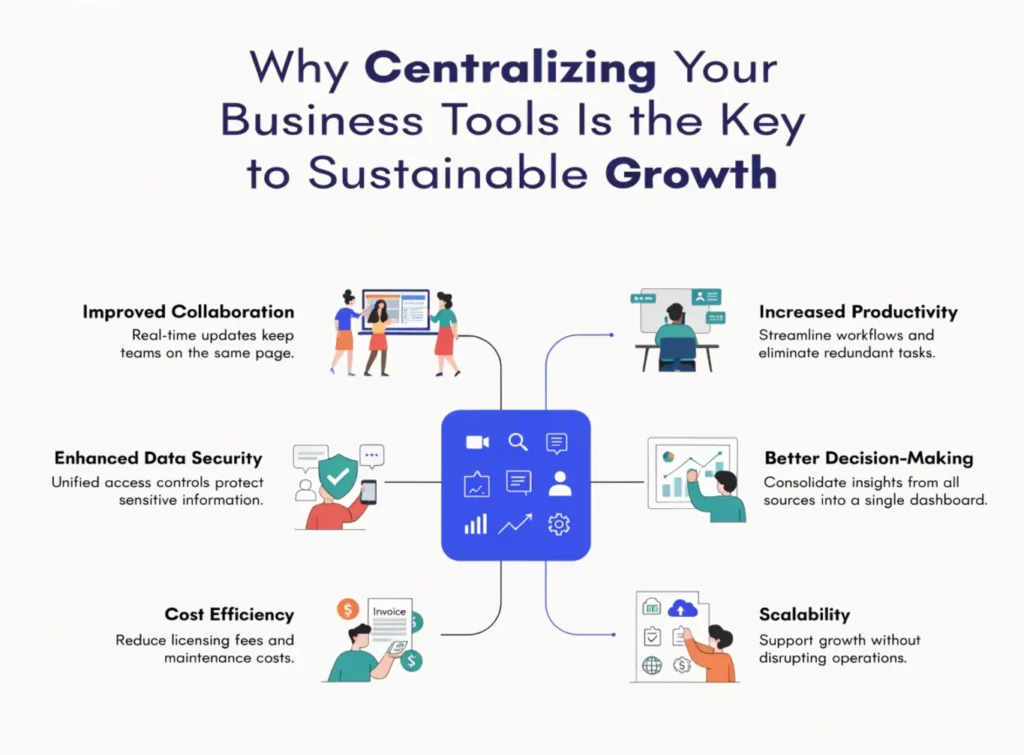
Most businesses don’t have a productivity problem – they have a fragmentation problem. The fix isn’t working harder or hiring more people. It’s building a tech stack where your tools actually talk to each other.
SaaS Fatigue Is A Real Operational Cost
A couple of years ago, adding another SaaS subscription was a sign of progress. By now, the average business is powered by dozens of disparate, disconnected platforms, each with its own login, UI, and database. The spread of this proliferation is called SaaS fatigue. And it’s even more expensive than your finance team thinks. The real cost only becomes apparent once you look at TCO – the total cost of ownership.
Not just licensing (though new research shows IT spending isn’t likely to go down any time soon) but training; integration; IT support; and, worst of all, the downtime when something goes wrong, and two not-meant-for-each-other systems are glitching, but the prospect of replacing one of them costs more and causes more outages than keeping both of them running. You add all that up, and the “cheaper” tool never is.
The Harvard Business Review was so concerned that they put a transactional cost on the TCO: the “toggle rate”, or the number of times an average employee switches between apps or tabs per day: 1,100. Nearly five weeks per year, all told. It’s tedious clicking, but more than that, it’s a direct hit to your bottom line.
Data Silos Block The Decisions That Matter
If all your sales data is recorded in one software, all customer service details are in another, and project schedules are in a third software, then you are not looking at the complete information which is the real scenario. You have three partial pictures and the decision-maker is likely to make decisions based on whatever information they can gather.
This need not be the case. With real-time data visibility, you can make decisions based on live information. This is possible only when you have a single source of information. New hires can also be onboarded easily if they have to focus on just one software interface rather than a dozen interfaces.
Centralization Is The Prerequisite For AI – Not The Other Way Around
Many technology conversations fail to mention an essential point: AI does not bring order out of disorder; it amplifies the existing order. A disjointed toolset doesn’t simply handicap AI; it mostly nullifies it, since the potential of AI is determined by the actual information that’s available.
If your tools are centralized, AI can perform a unique, valuable function: it can connect the dots. It can scan an incoming customer e-mail, cross-reference the CRM, tap into company knowledge, and even prepare a response – all in one environment, within seconds. That kind of workflow is impossible if the e-mail client, the CRM, and the knowledge management system are not based on a shared infrastructure.
This is why the transformation of platforms such as Microsoft 365 is so significant, going beyond just one more product launch or upgrade. As microsoft 365 ai integration comes into play, users can automate the creation of meeting minutes, draft a document, or access related company information in their respective environment, without needing to switch applications. And precisely because of the existing infrastructure, these kinds of workflow optimizations really come effectively to life.
Scalability Depends On Reducing Friction, Not Adding Headcount
Ensuring sustainable growth is sometimes viewed as a revenue issue. In reality, it’s frequently an operational issue. If a company’s production is reliant on manual organization between disparate systems, more coordinators are needed for growth. This is not a solution that can be scaled – it simply takes more time to reach the same limit.
Centralized platforms can change this dynamic. An organization can scale production through automated processes, drafting with the assistance of AI, and unified communications – without requiring a similar gain in administrative support. The system manages the coordination that previously necessitated human involvement.
The same is true for Cybersecurity. It is much easier to secure one ecosystem with uniform access controls and updates, as opposed to trying to secure 30 separate tools from 30 different vendors. Once an organization starts to grow, the areas of potential vulnerability multiply, but a centralized system can help to confine the risks.
Finally, let’s tackle the question of interoperability head-on: centralization does not equate to shutting out specialized tools. An excellently designed API ecosystem allows a centralized hub to draw from smaller platforms’ data where they are truly the best, without rendering them as silos. The hub remains the hub.
Build The Foundation First
Companies aiming to achieve AI-driven efficiencies, and in turn secure their futures, must begin by centralizing their data. Without this, none of the shiny tools that make everything move faster and smarter will ever have a chance to shine. To continue with the edifice metaphor: it’s the metal beams that support your structure.
