

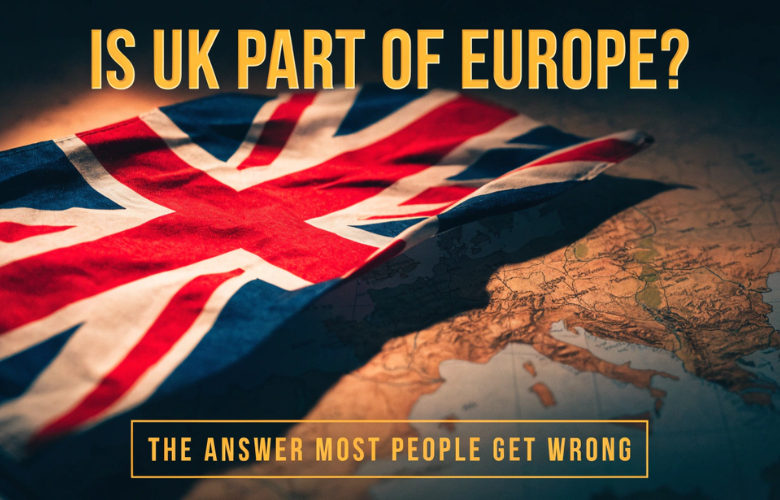
The question “is UK part of Europe“ continues to generate millions of searches every year. Since the United Kingdom left the European Union through Brexit, many people have become unsure whether Britain is still considered part of Europe. The confusion is understandable because the terms Europe, European Union (EU), Great Britain, and United Kingdom (UK) are often used interchangeably, even though they mean very different things. Understanding these differences is important for students, travellers, businesses, researchers, and anyone following international news. Geography determines where a country is located, while political organisations determine how countries work together. This guide explains the UK’s geographical position, its relationship with Europe, the impact of Brexit, and the differences between the UK, Great Britain, England, and the European Union. By the end, you will have a clear, factual answer supported by history, geography, and current affairs.
Is UK Part of Europe?
Yes, the United Kingdom is geographically part of Europe. The UK lies on the European continental shelf and is located just north-west of mainland Europe. Although the country is separated from France and other neighbouring nations by the English Channel and the North Sea, this does not change its continental location.
Many people assume that being an island means Britain belongs to a different continent. Geography does not work this way. Islands around the world are commonly grouped with the nearest continent. For example, Iceland is considered part of Europe, while Japan belongs to Asia despite being surrounded by water.
Britain has shared thousands of years of history with continental Europe. Ancient migration routes, trade, cultural exchange, scientific discoveries, and political alliances have all connected the UK with neighbouring European countries. Long before modern borders existed, Britain formed part of the wider European landscape.
Today, the United Kingdom continues to maintain strong economic, cultural, educational, and diplomatic relationships with European nations. Millions of people travel between Britain and mainland Europe each year, while businesses, universities, and research institutions continue working together across borders.
From a geographical perspective, nothing has changed. The United Kingdom remains part of Europe regardless of political developments.
Is UK Part of Europe Yes or No?
If you are looking for a simple answer, it is this:
Yes, the United Kingdom is part of Europe geographically.
No, the United Kingdom is not a member of the European Union.
These two statements explain why so many people become confused.
Europe is a continent made up of more than 40 countries. The United Kingdom is one of those countries because of its physical location.
The European Union is a political and economic partnership that brings together selected European countries to cooperate on trade, environmental standards, agriculture, consumer protection, and other shared policies. Membership is voluntary, and several European countries have chosen not to join.
Examples of European countries outside the EU include:
- United Kingdom
- Norway
- Switzerland
- Iceland
- Serbia
- Albania
- Bosnia and Herzegovina
Meanwhile, countries such as France, Germany, Spain, Italy, Portugal, Belgium, Ireland, and Poland are both European countries and European Union members.
Remembering this difference makes the answer much easier to understand. The UK is located in Europe, but it is no longer part of the European Union following Brexit.
Europe and the European Union Are Different
One of the biggest misconceptions online is that Europe and the European Union are the same thing. In reality, they are completely different.
Europe is one of the world’s seven continents. It includes countries with different governments, languages, cultures, economies, and political systems. Some European countries belong to the EU, while others do not.
The European Union is an international organisation created to encourage cooperation between member states. It develops shared policies on trade, environmental protection, consumer rights, transport, agriculture, and economic development. Membership depends on political agreements rather than geography.
This distinction explains why several countries are European without being EU members.
European countries outside the EU include:
- United Kingdom
- Norway
- Switzerland
- Iceland
- Montenegro
- Serbia
- Albania
European countries that are members of the EU include:
- France
- Germany
- Italy
- Spain
- Portugal
- Netherlands
- Belgium
- Sweden
- Denmark
- Ireland
Understanding this difference helps explain countless news stories, political discussions, and travel rules. Geography answers where a country is located, while the European Union explains how certain European countries cooperate politically and economically.
Why People Often Confuse Europe and the European Union
The confusion surrounding Britain’s place in Europe did not begin with Brexit, but it certainly increased after the referendum.
For many years, newspapers and television reports used the word Europe when discussing decisions made by the European Union. Over time, many readers and viewers began believing that Europe and the EU meant exactly the same thing.
Britain’s island location has also contributed to misunderstanding. Because the UK is separated from mainland Europe by the English Channel, some people mistakenly believe it belongs to a different continent. Similar misconceptions do not usually apply to countries such as Japan or Iceland, even though they are also island nations.
Another reason for confusion is everyday conversation. People often say they are “travelling to Europe” when they actually mean travelling from Britain to mainland European countries. While this expression is common, it does not mean Britain is outside Europe geographically.
Understanding these differences makes it much easier to interpret maps, international news, political debates, and discussions about Brexit.
Why Geography Still Places the UK in Europe
Geography is based on physical landforms rather than political agreements.
The United Kingdom sits on the European continental shelf, close to France, Belgium, the Netherlands, Norway, Denmark, and Ireland. Its location has remained unchanged for thousands of years.
Long before modern countries existed, Britain was connected to mainland Europe by a land bridge known as Doggerland. Rising sea levels eventually created the English Channel, separating Britain from continental Europe. Although this changed the landscape, it did not create a new continent.
Today, Europe remains the correct geographical classification for the United Kingdom because continents are defined by geology, physical geography, and internationally accepted conventions rather than political organisations.
This is why Brexit had no impact on Britain’s continental identity.
Is UK Part of Europe After Brexit?
One of the biggest reasons people search “is UK part of Europe” is because of Brexit. When the United Kingdom officially left the European Union on 31 January 2020, many people mistakenly believed it had also left Europe. In reality, Brexit changed the UK’s political and economic relationship with the EU, not its geographical location.
The UK remains a European country because continents are defined by geography, not by political organisations. Britain is still located on the European continental shelf and remains closely connected to neighbouring countries through trade, transport, tourism, education, science, defence, and diplomacy.
Brexit introduced changes to customs procedures, immigration policies, and trade agreements. Businesses exporting goods to EU countries now follow different customs rules, while travellers may notice updated passport and border requirements. Despite these changes, millions of people continue travelling between the UK and mainland Europe every year.
For anyone asking “after Brexit?”, the answer is straightforward. The United Kingdom left the European Union, but it remains geographically part of Europe. Understanding this distinction helps explain modern British politics, international relations, and cross-border cooperation.
Is UK Part of Europe 2026?
As of 2026, the answer remains yes. The United Kingdom is still geographically part of Europe while remaining outside the European Union. No political agreement can change the country’s physical location.
Britain continues to share strong economic, cultural, and historical ties with European nations. European countries remain among the UK’s largest trading partners, while British businesses continue exporting goods and services across the continent. Universities collaborate on research projects, airlines connect major European cities every day, and tourism continues to support millions of jobs.
Sport also demonstrates the UK’s European connections. British clubs compete in European football competitions, and athletes regularly participate in European championships across many sports. Scientific research, environmental initiatives, aviation agreements, and security cooperation further highlight Britain’s ongoing relationship with Europe.
Whether discussing geography, education, travel, or international affairs, the answer has not changed. The UK is part of Europe geographically, even though it is no longer an EU member.
Frequently Asked Questions
Is the UK considered part of Europe?
Yes. The UK is geographically part of Europe, even though it is no longer a member of the European Union.
Is the UK legally in Europe?
Yes. The UK is recognised as a European country geographically but operates outside the European Union following Brexit.
Is the UK out of Europe now?
No. Brexit removed the UK from the European Union, not from the European continent.
Why is the UK not part of the EU?
The UK left the European Union after the 2016 Brexit referendum and officially withdrew on 31 January 2020.
