

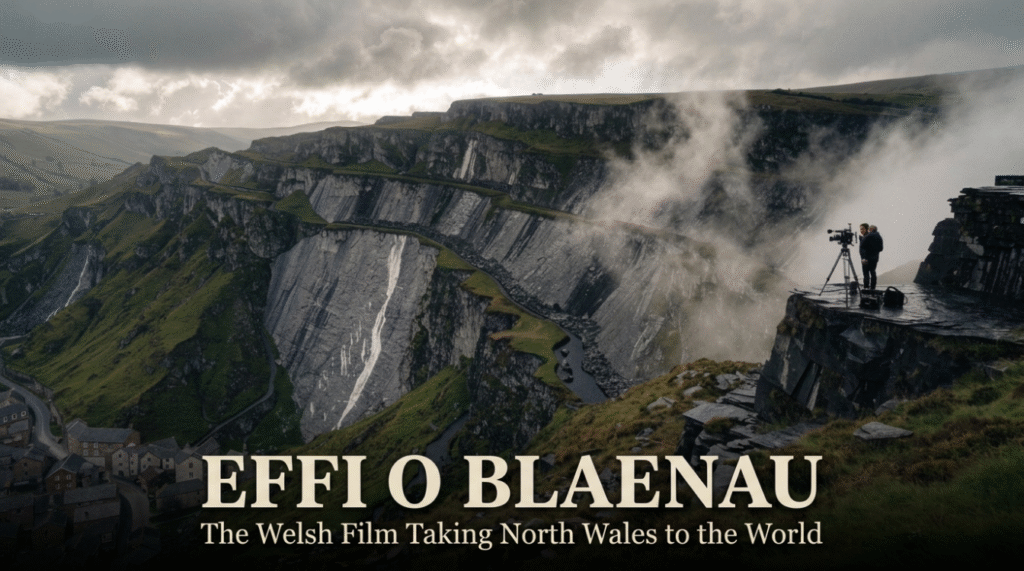
Effi o Blaenau is a 2026 Welsh-language drama film directed by Marc Evans and starring Leisa Gwenllian as Effi. Released in UK cinemas on 19 June 2026, the film has quickly become one of the most talked-about Welsh-language productions of the year, combining social realism, powerful performances and a distinctly North Wales setting.
The film is adapted from Gary Owen’s acclaimed stage play Iphigenia in Splott, but its story has been reworked for Blaenau Ffestiniog. That change gives the drama a new cultural and geographical identity while retaining the original play’s exploration of sacrifice, inequality and the pressures placed on vulnerable people.
Its growing reputation extends beyond Wales. Strong reviews, impressive box-office performance and international interest have helped position the film as a significant British independent release and a potential UK contender in the international awards conversation.
Effi o Blaenau Story and Plot
At the centre of the story is Effi, a young woman living in Blaenau Ffestiniog. Her life is marked by unemployment, heavy drinking, nights out and a sense that opportunities are disappearing around her.
Effi is not presented as a perfect or conventional heroine. She can be outspoken, reckless and confrontational, but beneath that exterior is a young woman trying to find meaning and stability in circumstances that offer very few easy choices.
Her life changes when she meets Lee, an injured former soldier, during a night out in Llandudno. Their encounter gives Effi a brief glimpse of another kind of future and introduces an emotional relationship that becomes increasingly important as the story develops.
The narrative eventually moves into much darker territory as Effi faces pregnancy, healthcare difficulties, personal loss and the consequences of living within systems that have failed to provide adequate support.
Rather than treating these events simply as individual misfortunes, the film connects them to broader questions about poverty, public services, class and social inequality.
Who Plays Effi o Blaenau?
Leisa Gwenllian takes the central role of Effi and is the film’s defining presence. Much of the drama depends on her ability to make Effi feel complicated rather than simply likeable or unlikeable.
Gwenllian brings considerable energy to the character, capturing Effi’s humour and confidence while gradually exposing the insecurity and vulnerability underneath. Her performance has been one of the most consistently praised elements of the film.
Tom Rhys Harries plays Lee, the injured ex-soldier who meets Effi in Llandudno. Owen Alun, Nel Rhys Lewis and Sion Eifion are also among the film’s supporting cast.
Key production details include:
- Leisa Gwenllian as Effi
- Tom Rhys Harries as Lee
- Owen Alun as Kev
- Marc Evans as director
- Gary Owen as the writer of the original stage play
- Branwen Cennard as screenwriter
- Eira Wyn Jones as cinematographer
- Elen Pierce Lewis as editor
The production has a strong Welsh creative identity, both behind and in front of the camera.
Is Effi o Blaenau Based on Iphigenia in Splott?
Yes. The film is a cinematic adaptation of Gary Owen’s acclaimed one-woman play Iphigenia in Splott, which was originally set in Cardiff.
The stage production drew inspiration from the ancient Greek story of Iphigenia, particularly its themes of sacrifice and the individual being placed under pressure by forces beyond their control.
For the film, the story was relocated from Cardiff to Blaenau Ffestiniog in North Wales. This is one of the most significant changes because the new location changes the social and visual context of the story.
Blaenau Ffestiniog has a strong industrial and slate-mining heritage, while the modern town has faced economic and social challenges. The setting therefore provides an effective environment for a story concerned with deprivation, limited opportunities and the consequences of political decisions.
The adaptation demonstrates how an established theatrical story can be transformed for cinema without losing its central emotional ideas.
Why Blaenau Ffestiniog Is Important to the Film
The choice of Blaenau Ffestiniog gives the film much of its personality. The North Wales town is historically associated with slate quarrying, industrial work and a distinctive mountainous landscape.
But the film does not simply use the area because it looks dramatic on screen. Its setting is closely connected to Effi’s circumstances and the social issues explored throughout the story.
The contrast between Blaenau’s industrial heritage and the difficulties facing some residents in the present day helps reinforce the film’s themes. Economic decline, unemployment and a shortage of opportunities become part of the environment in which Effi is trying to build her life.
This also gives the production cultural importance. Welsh cinema has often had to compete for attention with much larger English-language productions, so placing a Welsh-language story firmly within a North Wales community gives the film a distinctive voice.
The result is a setting that feels integral to the narrative rather than decorative.
The Main Themes Explored in Effi o Blaenau
Although the film follows one woman’s experiences, its themes extend far beyond Effi herself. Poverty and economic inequality are particularly important because her personal choices are repeatedly influenced by the opportunities available to her.
Healthcare is another major theme. The film examines maternity care and the pressures placed on public services, connecting Effi’s individual experiences with broader concerns about the NHS and social provision.
The story also explores the idea of sacrifice. This links directly to its source material and the ancient Greek mythology behind Iphigenia in Splott.
Important themes include:
- Poverty and economic inequality
- Unemployment and social stagnation
- Women’s experiences and vulnerability
- Pregnancy and maternity care
- Healthcare and public services
- Class and social disadvantage
- Rural and post-industrial communities
- Personal responsibility
- Sacrifice and resilience
- Welsh identity and language
These themes give the film relevance beyond its immediate setting. Although the story is firmly rooted in North Wales, many of the issues it raises will be familiar to audiences throughout the UK.
What Makes Stand Out?
What makes Effi o Blaenau distinctive is the way it combines a deeply personal story with wider questions about modern Welsh society. Rather than treating Blaenau Ffestiniog simply as a scenic backdrop, the film places its characters within a post-industrial community where economic decline, limited opportunities and social pressures influence everyday life.
Leisa Gwenllian is another major reason the film stands out. Her portrayal of Effi moves between humour, anger, confidence and vulnerability, giving the character considerably more depth than a conventional coming-of-age protagonist.
The film also benefits from its Welsh-language identity. English subtitles make it accessible to a wider UK audience, while the Welsh dialogue helps preserve the cultural character of the setting.
Its strongest qualities include:
- A powerful central performance from Leisa Gwenllian
- A distinctive North Wales setting
- A modern interpretation of classical Greek mythology
- Strong social and political themes
- A Welsh-language story aimed at a broad cinema audience
- A thoughtful adaptation of Gary Owen’s Iphigenia in Splott
- A combination of intimate character drama and wider social commentary
The result is a film that offers audiences something to think about rather than simply something to watch.
Critical Reception and Reviews
The critical response to the film has been notably strong. Reviewers have praised Marc Evans’ direction, the screenplay and particularly Leisa Gwenllian’s central performance.
The Guardian described the film in highly enthusiastic terms, while other critics have highlighted its combination of social realism and more heightened, poetic filmmaking. Comparisons with the tradition of British social-realist cinema have also appeared, although the film develops a visual and cultural identity of its own.
The response is significant because Welsh-language films do not always receive the same level of international attention as major English-language productions.
The film’s reception has been driven by several factors:
- Strong reviews from film critics
- Leisa Gwenllian’s acclaimed performance
- The distinctive Blaenau Ffestiniog setting
- Its contemporary treatment of serious social issues
- The successful transition from theatre to cinema
- Interest in Welsh-language filmmaking
Its critical reputation has helped transform it from a regional Welsh production into a film attracting wider UK and international attention.
Effi o Blaenau Box Office Success
One of the biggest developments surrounding the film has been its box-office performance. Following its UK theatrical release, Effi o Blaenau achieved a significant milestone by becoming the highest-grossing Welsh-language film at the box office.
That achievement is particularly notable because Welsh-language cinema operates within a much smaller potential domestic audience than mainstream English-language films.
The film’s performance demonstrates that a story rooted in a specific Welsh community can attract audiences beyond its immediate linguistic and geographical market.
Its success also strengthens the commercial case for Welsh-language feature films. A strong theatrical performance can encourage distributors, broadcasters and producers to invest in more stories made in Wales and told through the Welsh language.
The film’s box-office progress is therefore important not only as an individual achievement but also as a potential indicator of growing audience interest in Welsh cinema.
Effi o Blaenau and the Oscars
The film has also attracted attention because of its position as a potential UK international Oscar contender.
Its Welsh-language identity makes the awards conversation particularly interesting because international recognition could bring greater visibility to Welsh filmmaking and the wider creative industries in Wales.
An Oscar campaign does not guarantee a nomination. Films must go through the relevant national selection and Academy processes before reaching the final shortlist and nominations.
Nevertheless, being discussed as a UK contender is already an important achievement. It places the film in a wider international conversation and could introduce Marc Evans, Leisa Gwenllian and Welsh-language cinema to audiences who may not otherwise encounter their work.
The film’s combination of critical acclaim, cultural identity and box-office success provides a strong foundation for that international conversation.
Where Was Effi o Blaenau Filmed?
The film was shot across several Welsh locations, with Blaenau Ffestiniog providing its central geographical identity. Caernarfon and Port Talbot were also among the locations associated with the production.
Blaenau Ffestiniog was an especially appropriate choice because the town’s physical landscape reflects the story’s themes. Its slate heritage, mountains and post-industrial environment provide a distinctive cinematic setting.
Using real Welsh locations also contributes to the film’s sense of authenticity. Rather than recreating a fictional version of North Wales in a studio, the production places Effi within recognisable communities and landscapes.
For viewers interested in Welsh film locations, the production provides an opportunity to see North Wales represented through contemporary drama rather than through the more familiar tourism-focused imagery often associated with the region.
Effi o Blaenau Release Date and Key Facts
The film was released in UK cinemas on 19 June 2026. It is a Welsh-language drama with English subtitles and has a running time of approximately 90 to 91 minutes.
Here are the key facts at a glance:
- Title: Effi o Blaenau
- Release year: 2026
- UK release date: 19 June 2026
- Director: Marc Evans
- Lead actor: Leisa Gwenllian
- Genre: Welsh-language drama
- Language: Welsh
- Subtitles: English
- Runtime: Approximately 90–91 minutes
- Source material: Iphigenia in Splott
- Original playwright: Gary Owen
- Main setting: Blaenau Ffestiniog
- UK distributor: MetFilm Distribution
- Age rating: 15
The film’s combination of Welsh language, contemporary social themes and a North Wales setting makes it particularly significant within the 2026 British cinema landscape.
Who Should Watch Effi o Blaenau?
This film is best suited to viewers who enjoy character-driven dramas rather than conventional blockbuster entertainment. Its focus is on people, relationships and social circumstances rather than action or spectacle.
It should appeal particularly to audiences interested in Welsh culture and language. However, you do not need to speak Welsh to understand or appreciate the film because English subtitles provide access to the dialogue.
It is also a strong choice for people interested in adaptations. Those familiar with Iphigenia in Splott may find the relocation from Cardiff to Blaenau Ffestiniog particularly interesting.
The film is worth considering if you enjoy:
- British social-realist cinema
- Welsh-language productions
- Strong female lead characters
- Theatre-to-film adaptations
- Social and political dramas
- Stories about working-class communities
- Films exploring healthcare and inequality
- Contemporary interpretations of mythology
Viewers should be aware that the film contains mature and upsetting material and is rated 15 in the UK.
Is Worth Watching?
Yes, particularly if you prefer films with emotional depth and something meaningful to say.
The strongest argument for watching is the combination of Leisa Gwenllian’s performance and the film’s social setting. Effi is not written as a flawless protagonist, which makes her journey more complicated and believable. Her decisions can be frustrating, funny, impulsive or heartbreaking, sometimes within the same sequence.
The Welsh-language presentation is another major strength. It gives the film a sense of place that could have been lost if the story had simply been transferred into English.
The film is not necessarily an easy watch. Its treatment of pregnancy, healthcare, poverty and personal loss can be emotionally demanding, and its social commentary is deliberately uncomfortable.
However, that seriousness is precisely why it works. is more than a coming-of-age drama; it is an ambitious film about what happens when individual lives collide with wider social pressures.
Where Can You Watch Effi o Blaenau?
Began its UK cinema run on 19 June 2026. Availability can vary between cinemas, particularly as theatrical schedules change after a film’s initial release period.
The film is presented in Welsh with English subtitles, so viewers should check individual screening information if subtitles are important to them.
S4C has also announced plans involving the film’s future availability through its broadcasting and streaming platforms, including S4C, Clic and BBC iPlayer.
For viewers looking for the film, the most useful information to check is:
- Current cinema screenings
- Local independent cinema programmes
- Welsh film events and festivals
- English-subtitle availability
- Future S4C scheduling
- Streaming availability after the theatrical run
Because release arrangements can change, current listings are the best way to confirm where the film is available at any particular time.
Also Read More :Kathryn Chalk: The Met Office to GB News – A Look at Her …
Frequently Asked Questions
What is Effi o Blaenau about?
It is a 2026 Welsh-language drama about Effi, a young woman living in Blaenau Ffestiniog. After meeting injured soldier Lee, her life takes an unexpected turn, leading to a story involving relationships, pregnancy, healthcare, poverty, loss and social inequality.
Who plays Effi in the film?
Leisa Gwenllian plays the title character. Her performance is central to the film and has received considerable praise from critics for combining Effi’s confidence, humour, anger and vulnerability.
Is based on a true story?
No. The film is fictional. It is adapted from Gary Owen’s stage play Iphigenia in Splott, which itself draws on the ancient Greek story of Iphigenia.
Is a Welsh-language film?
Yes. The dialogue is primarily in Welsh and the film is designed for audiences both within Wales and internationally. English subtitles make it accessible to people who do not speak Welsh.
What is the Effi o Blaenau age rating?
The film has a 15 certificate in the UK. Its mature classification reflects strong language, sexual content and difficult themes involving pregnancy, loss, drugs, violence and injury.
Final Verdict
Is an ambitious Welsh-language film that succeeds by making one woman’s story feel connected to much larger questions about modern Britain. Its move from the Cardiff setting of Iphigenia in Splott to Blaenau Ffestiniog gives Gary Owen’s story a distinctive North Wales identity, while Marc Evans’ direction brings the material to cinema with a strong sense of place.
Leisa Gwenllian is the film’s biggest asset. Her performance makes Effi complicated, unpredictable and deeply human, ensuring that the character cannot be reduced to a simple symbol of poverty or social disadvantage.
Its critical reception and box-office success make the film an important moment for Welsh cinema, while its reported Oscar hopes could take that conversation even further. It is challenging viewing, but that challenge is part of its value. For anyone interested in Welsh culture, powerful performances and socially conscious British cinema, Effi o Blaenau is well worth watching.
