

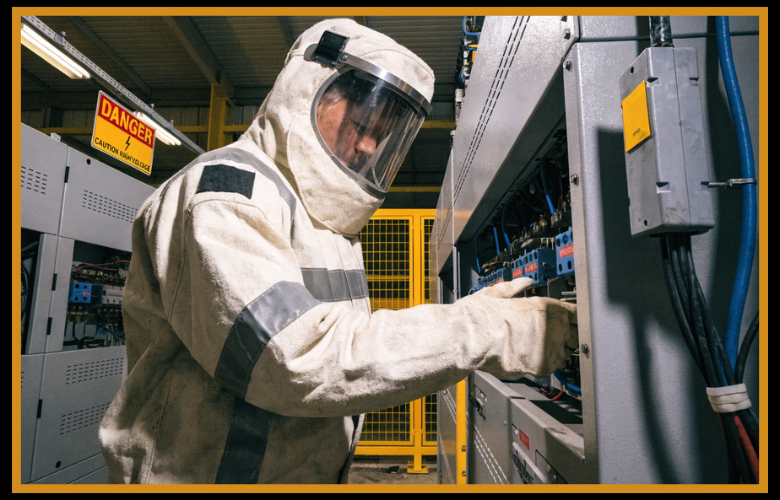
There is no room for error in high-voltage environments. Any oversight, such as a missed isolation point, a mislabeled conductor, or the lack of a dielectric test for a glove in two years, can lead to an arc flash event. This may result in workers being sent to burn units and critical infrastructure being shut down for weeks. To establish an effective safety program, you must consider safety as an engineering discipline, rather than as an exercise in compliance.
Start with the arc flash hazard analysis
To prioritize the safety of individuals, you must first understand the risks they face. An arc flash risk evaluation defines the incident energy levels present in every high-voltage component in your building. This is not merely a report that you can file away and forget about; it forms the basis of every Personal Protective Equipment (PPE) determination, every warning sign, and every maintenance task your staff will conduct.
The evaluation returns two critical outputs: the incident energy values generated (cal/cm²) and the arc flash boundary distances. These values determine the appropriate PPE category. In the NFPA 70E standard’s system, PPE categories vary from 1 through 4, with the lowest category intended for reduced incident energy exposures and the highest category intended to cover the most extreme exposure your devices present. The error most facilities commit is applying a fixed category to all devices rather than assess the situation per device.
Your building’s single-line diagrams (SLDs) hold elite status in this process. Without precise, updated SLDs that recognize the presence of every overcurrent protective device (OCPD) in your system – meaning, the breakers, the fuses, and the OCPDs response times – you cannot predict incident energy. If the SLDs are not current because assets in the system have been upgraded or the switchgear replaced, you need to correct that right away. The OCPD coordination information is employed in determining the arc flash duration, which, in turn, establishes how ruinous the event will turn out to be.
Build LOTO procedures that prove the zero-energy state
Lockout/tagout for high-voltage is distinct from LOTO for low-voltage. The risks and characteristics are not the same. The physics are different. What keeps you safe around a 480V panel is not always adequate for a 6.6kV system and the stakes are too high to cross your fingers and hope for the best.
First, test before touch is the most important rule you can follow. After applying all your locks and all your tags every single person coming to the worksite needs to use an approved, calibrated-for-the-system-voltage, voltage detector to verify that you have achieved a de-energized state.
Not a contact tester from your hip. Not a guess based on the position of the breaker. And not an assumption based on the work permit. The voltage detector should be activated pre-use on a known live source. Then used to confirm the absence of voltage. Then re-tested on the same live source. It sounds redundant. It isn’t.
It should be the cornerstone of your LOTO process. A procedure that’s quite solid will also identify every energy source, not just the most obvious. Capacitor banks, backfeed paths, and induction from adjacent energized conductors all make that list. Every source gets isolated using a visible break device. Your device. A device that you confirm is open. Your source is open.
Match PPE to the numbers, then maintain it
Once you have calculated the incident energy, PPE selection is a simple math problem. The arc-rated clothing needs an arc thermal performance value (ATPV) that is equal to or greater than the incident energy calculated for the work position. For high-voltage face protection, you need an arc-rated face shield – it must be an arc-rated shield, not just an impact-rated shield. The two terms are NOT interchangeable.
The component of any PPE program that degrades most rapidly is rubber insulating equipment: gloves, mats, and blankets. You have to perform dielectric testing on a schedule to verify that the equipment can still handle the voltages for which it’s rated. Rubber insulating gloves that are visually pristine can still have micro-punctures or surface degradation that will compromise their high-voltage protection. A visual inspection before each use, along with scheduled laboratory dielectric testing, is the only way to know for sure.
Finally, you need a good tagging and rotation system. Every pair of rubber insulating gloves in your facility should have a test date, an in-service date, and a maximum service life. The guys in the field shouldn’t have to guess whether the gloves in the cabinet are still good. If you discover that equipment gets used past its test date because “there’s nothing else in the cabinet,” that’s a program management failure, not a worker failure.
Control approach boundaries and keep untrained people out
Boundary distances specified in NFPA 70E establish three zones surrounding energized electrical conductors: limited, restricted, and prohibited. They’re each associated with different entry and protective requirements.
Unqualified personnel – meaning anyone who hasn’t received the necessary theoretical and hands-on training to qualify as a “qualified person” for the specific type of equipment in question – may not enter the limited approach boundary unless accompanied by a qualified person and the arc flash risk is suitably mitigated. The restricted approach boundary is strictly limited to qualified persons, who must be wearing appropriate PPE at the time. The prohibited boundary (sometimes also known as the arc flash boundary in certain standards) is the given distance from exposed live parts where an employee would sustain a second-degree burn if an electrical arc flash occurred.
In an area of a plant or substation where operators, contractors, or other workers may share space with electrical equipment, all three boundaries must be physically marked and substantially barricaded during energized work or nearby maintenance. Simply informing unscheduled bystanders either verbally or in writing that they’re too close to live equipment isn’t good enough. The boundaries must be established before work begins and physically removed only after the equipment has been de-energized.
Partner with qualified personnel for complex work
Installation of new equipment, modification of the switchboard, or change in the electrical system can be common tasks for your general maintenance team but these tasks can expose your workers to unacceptable risk when the work involves high voltage. These are tasks that qualified and experienced industrial electricians need to manage. Are you giving potentially lethal tasks to employees who you otherwise expect will make it to retirement with all their fingers and toes? Would they get full-time pay for the rest of their life if they lose one of those parts? Then entrust this work to the professionals.
NFPA 70E language describing who should do energized work is based on risk and whether it takes place within the restricted approach boundary or not. Complex installations, switchboard modifications, and system commissioning are exactly the type of tasks that the language was written to address. They are unique to the equipment, infrastructures and architecture, which means typically there are no right or wrong answers; however, one wrong answer can be catastrophic. Leave these tasks to others.
You may have plenty of electrically qualified employees and they may have all the latest accessories hung off their tool belt. You still don’t want them doing this type of work. Too much can go wrong and too much can be lost.
Shift from administrative controls to engineering solutions
Administrative controls like procedures, training, and PPE reduce your exposure to hazards. Engineering controls eliminate or reduce the hazard itself. If we had an infinite budget, we’d engineer every hazard out of existence. For all of us in high-voltage environments, the goal of any engineered control is to move up that ladder wherever possible.
Arc-resistant gear is engineered to contain and direct the energy of an arc flash out of the gear and away from the operator. Maintenance mode switches on modern protective relays can be used to reduce the arc flash incident energy by enabling faster tripping times during planned maintenance. This eliminates the need to conduct cumbersome secondary injection tests on the relay and allows the breaker to open much faster during an arcing fault.
Remote racking devices let workers stand 10 or 20 feet away while a geared winch inserted in the breaker lineup rolls the drawout from the cell and into the truck. This simple setup eliminates the highest-risk moment of your switching operation by putting distance between the moment of breaker-insertion and your team.
Use the energized electrical work permit as a hard gate
Most regulatory frameworks require a formal permit for live high-voltage work – electrical work performed on or near energized conductors. Yours surely should. The best practice energized electrical work permits (EEWP) process makes the planning team document: why de-energizing wasn’t reasonable or would introduce more risk; specifically, what controls you have in mind; who is authorized and qualified to do the work and what the rescue plan is.
The EEWP process shouldn’t be a “rubber stamp” process. If your safety culture treats it as just some paperwork to fill out after the decision to do live work is already made, as opposed to a key process control, then it isn’t working right. It should be the process that makes the decision of whether or not live work is done at all.
Permit requests that are turned down (where the process determines that the work can and should be done de-energized) should be counted as successes, not complaints.
Train for emergencies specific to high-voltage incidents
Injuries caused by high-voltage arc flashes and electrocutions are serious and need to be treated with specialized emergency response procedures, distinct from typical first aid measures. Our typical first responders need to be well-trained in dealing with such incidents.
When it comes to high-voltage rescue, the first and most important rule is that rescuers should not become victims themselves. High voltage will pass through the victim and into the rescuer if the victim is still in contact with the energized conductor. Therefore, non-conductive rescue hooks that are at or above the system voltage should be available in high-voltage work locations. Workers should be familiar with the location and operation of these hooks before any incidents occur.
Arc flash burns are extensive and must be treated by medical professionals immediately. Your emergency response plan should identify the closest facility with a burn unit instead of just the closest emergency room. Send the facility samples of the clothing worn by your workers to get them to understand the materials they may need to treat.
Your high-voltage emergency drills should be carried out at least once a year. The shock, noise, and flames from a high-voltage arc flash can be overwhelming. Workers who have practiced their emergency response actions will be more effective than those encountering the situation for the first time.
Audit qualifications and the program itself
Safety programs can become ineffective if they are not actively monitored and updated. As staff members change, new equipment is introduced, and new practices are implemented, without proper adjustments old safety guidelines are still followed. To prevent this from happening, regular audits should be incorporated into the structure of the safety program, at least annually.
Qualification audits should ensure that anyone assigned to work with high-voltage electrical systems is properly trained and equipped to do so. Review their training and assessment documents, confirm that any modifications to the system have been assessed for arc flash risk, ensure that their protective gear has been recently tested, and look into permits issued in the previous year to identify any recurring issues.
Even the best safety program can become outdated if left unchecked for three years. This is why annual audits are so important.
