

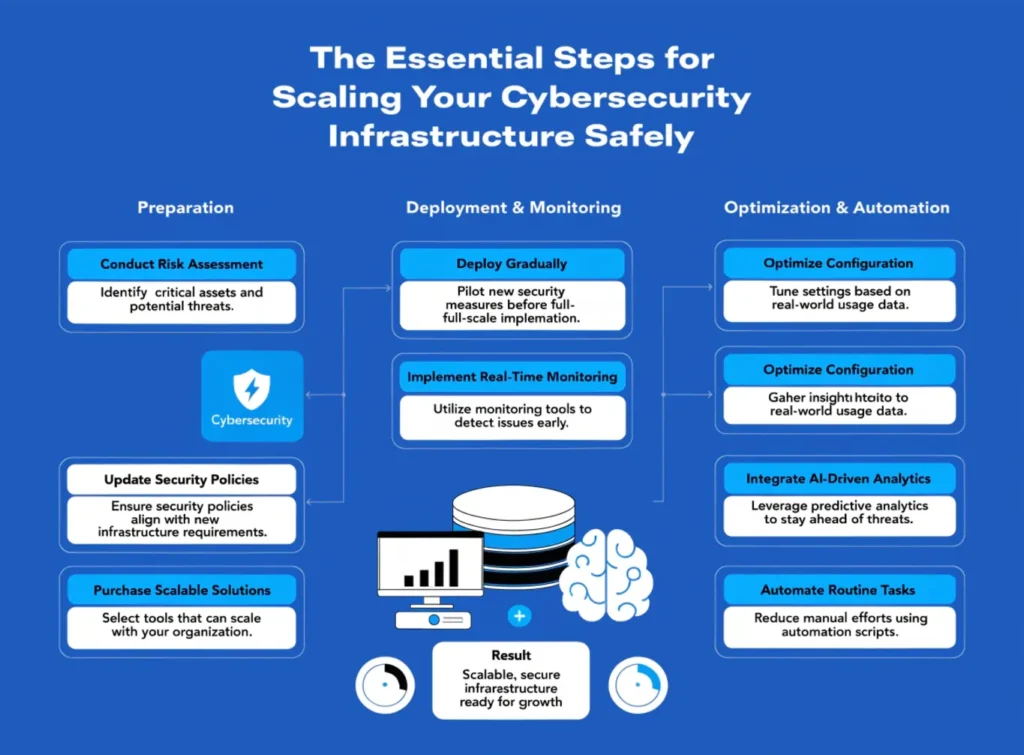
Many organizations perceive cybersecurity compliance as a problem they will address once they are bigger. Unfortunately, by the time that happens, many will have already faced a breach, a failed audit or even lost a major contract because of their approach to security and compliance. None of these outcomes is likely to contribute to future growth.
Build compliance into the architecture, not onto it
The most significant error we notice in infrastructure growth is when security is viewed as an add-on layer. Rather, every new server, cloud instance, or application that you add to your environment needs to be checked or tested with your compliance baseline starting from day one.
In real life, “compliance-by-design” looks like this: your deployment templates are made up of solidified configurations, admittance regulations are determined before users are licensed, and your new tools are assessed with your Governance, Risk, and Compliance structure before procurement – instead of after. You receive a solid set of commands to start constructing from, particularly if your business manages Controlled Unclassified Information.
Centralize visibility before you expand
Decentralized log management can be one of the most reliable ways to ensure you miss a breach during a period of rapid growth. It’s easy to underestimate the effect of disparate, siloed data, especially when you’re forced to adopt more remote endpoints, cloud environments, and third-party integration points than you ever planned for.
Centralizing your monitoring – be that via a SIEM platform or an alternative that fits your business – gives your security team a single view of all events, on all systems, in all environments. Coupled with Endpoint Detection and Response on every endpoint you manage (which, in a modern infrastructure, should be every device you contribute to the network, including IoT endpoints), you can maintain some level of visibility amidst the swarm of new devices that are likely added daily.
Without this basic foundation, you’re not scaling your infrastructure. You’re scaling your blind spots.
Move to Zero Trust before your perimeter disappears
The idea behind traditional perimeter-based security was that every entity within your network could be trusted. However, this assumption quickly proves wrong as soon as you start adding remote employees, SaaS applications, or hybrid cloud systems (in other words, very early in the lifecycle of any company that’s going to be successful).
Zero Trust Architecture instead assumes that no entity can be automatically trusted and requires verification for every user, device, and request on every interaction. This means implementing Multi-Factor Authentication on all systems, tightening Identity and Access Management so users only have access to what their role requires, and treating any movement from one part of the system to another as a possible threat to be identified, instead of a regular process to be tolerated.
But transitioning to Zero Trust can’t be a wholesale switch. It has to be part of your infrastructure roadmap and implemented step by step, with each new system brought online under the new, more secure criteria.
Automate patch management and audit readiness
The number of endpoints security teams are responsible for does not increase at the same rate as staff numbers. It’s automation that bridges that gap.
Automated patch management and vulnerability scanning tools mean you can maintain coverage across a large and growing environment without needing to make a proportional increase in headcount.
It pays to do this too – as the IBM Cost ofa a Data Breach Report points out, companies using high levels of security AI and automation saved significant amounts in breach costs compared to those that did not.
The same applies to audit readiness. Run internal mock assessments regularly and it’s easy to see how. They help you spot ‘compliance drift’ – the gradual weakening of security controls that happens when operational changes outpace policy updates. A control that was working six months ago may not be configured correctly today if a system was patched, migrated, or modified without a compliance review.
Prepare your supply chain and your federal posture
Growing your business through scaling leads you to work with multiple vendors, subcontractors, and partners. If their security practices are not aligned with your standards, they could be vulnerabilities for your company. Third-Party Risk Management should not be taken lightly. It’s something to be considered even during the vendor selection process, and basic security conditions should be negotiated before any deal is made.
For those working in, or considering federal contracting, this is the point at which cmmc readiness becomes crucial in the decision-making process. A gap analysis gives you a realistic view of your compliance status, identifying where you are meeting CMMC requirements and where you fall short. This is information you need in order to plan remediation before an assessor arrives, not to mention before DoD is requiring CMMC certificates from all bidders this year.
Security posture as a competitive asset
Businesses that integrate stringent cybersecurity compliance with their expansion can safeguard against more than breaches. They transform into the type of entity which prominent associates and governmental customers would prefer to engage with. That’s the ultimate advantage. A solid compliance stance doesn’t restrict your potential – it indicates that your system can manage what is on the horizon.
