

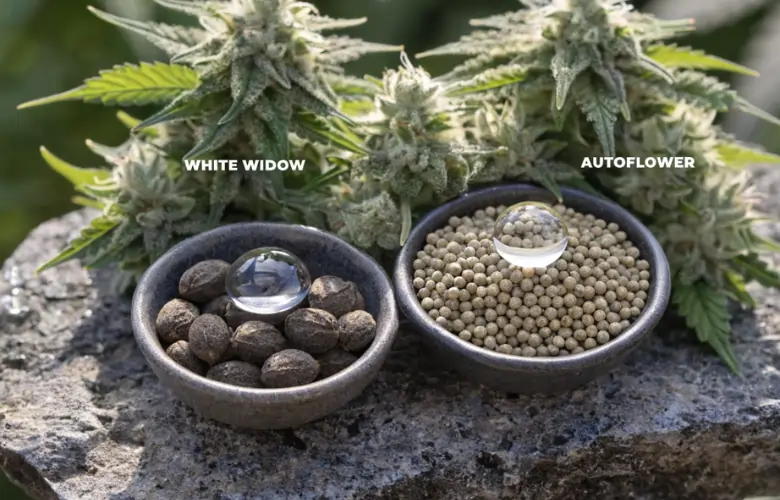
As cannabis genetics continue to evolve, the focus has shifted toward combining classic traits with modern breeding efficiency. In this context, White Widow remains one of the most recognizable legacy cultivars, while autoflower seeds represent a significant advancement in genetic timing and predictability. Together, they illustrate how traditional breeding foundations can merge with innovation to meet the expectations of a more informed and research-driven market.
White Widow: A Benchmark for Resin and Stability
White Widow has maintained its reputation for decades due to its consistent structure and dense resin production. Developed from a combination of Brazilian sativa and South Indian indica genetics, it quickly became a reference point for hybrid stability.
One of the defining characteristics of White Widow is its balanced growth pattern. It typically exhibits medium height, strong lateral branching, and compact flower formation. These traits have made it a reliable choice in breeding programs where structural consistency is essential.
Aromatically, White Widow is often associated with earthy and woody notes, layered with subtle spice and mild citrus undertones. Its terpene composition frequently includes myrcene and caryophyllene, contributing to a well-rounded sensory profile. Rather than overwhelming intensity, it offers a balanced aromatic expression that integrates effectively into hybrid lines.
Autoflower Seeds: Internal Timing and Genetic Precision
In contrast to traditional seed types, autoflower seeds are bred to transition from vegetative growth to flowering based on age rather than light cycles. This internal timing mechanism originates from Cannabis ruderalis, a subspecies adapted to environments with shorter and less predictable growing seasons.
The key advantage of autoflower seeds lies in their predictability. Once germinated, plants follow a fixed lifecycle, reducing dependence on environmental variables. This characteristic has made them increasingly popular among those seeking consistency and efficiency in plant development.
Structurally, autoflowering varieties are often more compact and complete their lifecycle within a shorter timeframe. However, modern breeding has significantly improved their quality, allowing them to retain desirable traits such as resin production and terpene complexity.
Combining White Widow with Autoflowering Genetics
The integration of White Widow into autoflower seeds highlights how classic genetics can be adapted to modern breeding techniques. By introducing ruderalis traits into a stable hybrid like White Widow, breeders can create seed lines that maintain resin density while benefiting from automated flowering cycles.
This process requires careful stabilization. Breeders must ensure that the defining traits of White Widow—such as its structure and terpene profile—are preserved while incorporating the timing efficiency of autoflowering genetics. Achieving this balance involves multiple generations of selection and refinement.
The result is a hybrid category that reflects both heritage and innovation, offering a more controlled and predictable genetic framework.
Stability, Transparency, and Buyer Expectations
As the cannabis seed market becomes more sophisticated, buyers are increasingly focused on stability and transparency. When evaluating White Widow or autoflower seeds, they often look for detailed lineage documentation, phenotype descriptions, and breeder credibility.
Stabilized seed lines are essential for ensuring consistent results. Without proper refinement, genetic variation can lead to unpredictable outcomes. Reputable breeders address this by carefully selecting parent plants and maintaining clear records of their breeding processes.
In addition, proper storage and handling play a critical role in preserving seed viability. Controlled environmental conditions help maintain the genetic integrity of seeds until they are ready for use.
Terpene Expression and Modern Selection Criteria
Beyond structural traits, terpene profiles have become a key factor in seed selection. White Widow contributes a grounded aromatic base, while autoflowering genetics allow these characteristics to be expressed within a more controlled lifecycle.
Modern buyers often evaluate seeds based on both cannabinoid and terpene data. This dual focus reflects a broader understanding of how genetic traits interact to shape overall plant characteristics.
By combining classic terpene frameworks with modern breeding techniques, seed developers continue to refine the balance between tradition and innovation.
A Contemporary Perspective on Genetic Development
The relationship between White Widow and autoflower seeds illustrates a broader trend in cannabis breeding: the integration of established genetics with advanced techniques. Rather than replacing traditional cultivars, breeders adapt them to align with evolving expectations.
For those researching seed options, this highlights the importance of looking beyond surface-level descriptions. Understanding how genetics are developed, stabilized, and preserved provides valuable insight into overall quality.
Conclusion: Tradition Meets Innovation
White Widow represents a legacy of stability and resin production, while autoflower seeds showcase the precision of modern genetic engineering. Together, they demonstrate how cannabis breeding continues to evolve through thoughtful integration of past and present.
By focusing on lineage, stabilization, and transparency, today’s buyers can navigate the seed market with greater confidence. This informed approach ensures that both classic and modern genetics are appreciated not just for their reputation, but for the careful processes that define their quality.
